
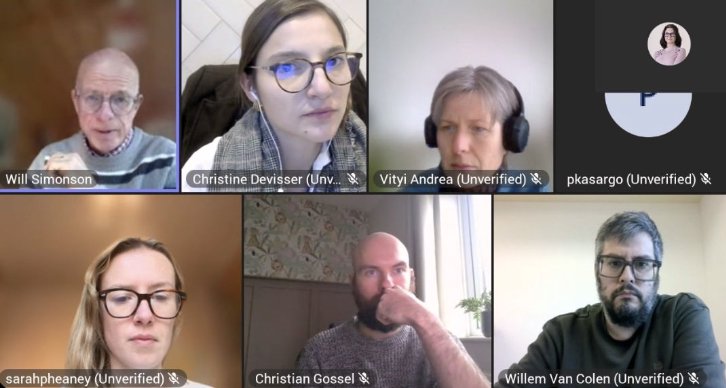
ReForest’s Training & Upskilling Farmers Working Group held a meeting to exchange insights from Living Labs across Europe and share practical experience on what makes agroforestry training truly effective. The working group is led by Will Simonson from the Organic Research Centre, who is leading the ReForest Living Lab in UK.
The discussion highlighted several key takeaways, confirming that successful agroforestry training relies not only on technical content, but also on the right learning formats and participant dynamics.
Peer-to-peer learning is essential
Partners from the Belgium Living Lab, led by Inagro vzw, emphasised the importance of farmer-to-farmer exchange.
Peer learning creates an open and practical environment where participants can compare approaches, learn from real examples, and build confidence in applying agroforestry practices.
Interestingly, the group also noted that agroforestry training works particularly well when participants come from different experience levels. A group that is not “too coherent” can make discussions richer and more useful, allowing both newcomers and experienced practitioners to learn from each other.
Real-life experience builds engagement
Insights from the UK Living Lab confirmed the value of experience-based learning formats. Both the first ReForest training webinar and the face-to-face co-creation workshop organised during the Agroforestry Show attracted strong interest.
These activities reinforced an important lesson: agroforestry learning is most effective when it is grounded in practical stories and lived experience, creating space for discussion, reflection, and real-world examples.
Training should match the needs of different audiences
The working group also highlighted the importance of tailoring training activities to different audiences. While advisors benefit from understanding the full range of agroforestry options and system designs, farmers tend to benefit most from training that stays local, practical, and relevant to their regional context.
Across discussions, participants also confirmed that training sessions become more valuable when they include practical decision-support tools, helping learners explore options, assess impacts, and plan implementation steps.
Representatives of the Hungarian living lab confirmed these key observations. They have launched an educational programme involving highly diverse participant groups, including farmers and advisors of different ages, with both small-scale and large-scale farming backgrounds.
A particularly successful element is the organisation of Living Lab visits, which are open to a broad audience and provide opportunities for direct exchange with ReForest farmers and real agroforestry systems in practice.
ReForest warmly invites agroforestry stakeholders to contribute to this ongoing exchange on learning and training. If you have experience with agroforestry education, training formats, or knowledge-sharing approaches, we welcome your input and reflections.
To participate, you can join the next working group meeting and share your insights:
https://reforest.euromed-economists.org/groups/
 Bulgarian
  English
  German
  French
  Spanish
  Danish
  Hungarian
  Czech
Czech  Dutch
Dutch