
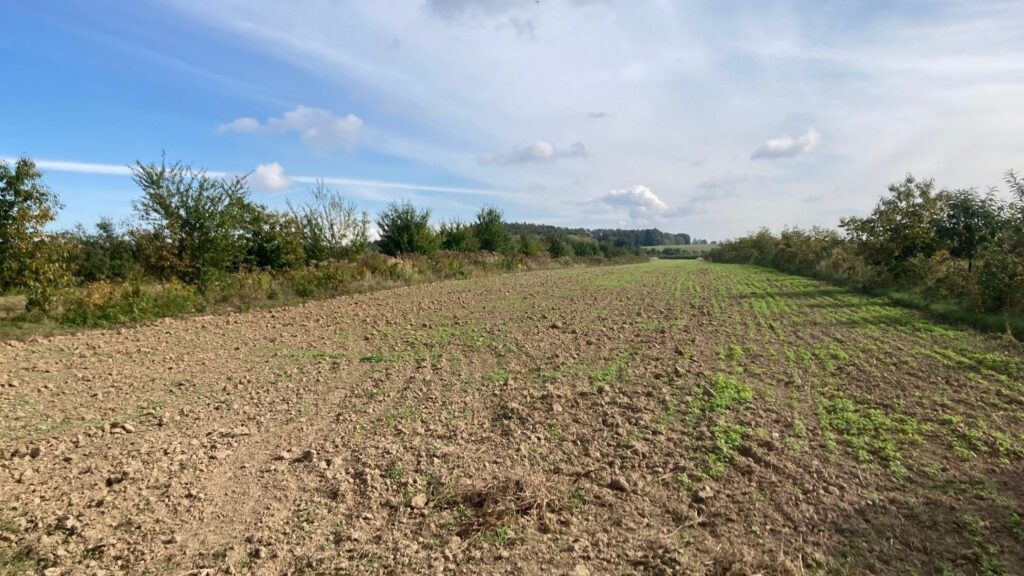
Plužiny: Historical Field Patterns as Living Agroforestry Heritage
In the Czech Republic, historical plužiny systems represent an important part of cultural landscape heritage. These traditional field structures were formed over centuries through cultivation practices, land ownership and local knowledge. Narrow, elongated plots were often bordered by grass strips, field margins, hedgerows, shrubs and tree lines, creating a clear and functional rural landscape.
Plužiny were not only productive agricultural spaces. They also marked boundaries, supported orientation in the landscape and carried the memory of rural communities. During the 20th century, land consolidation and agricultural intensification disrupted many of these structures, leading to more homogeneous landscapes and a loss of historical continuity.
Agroforestry offers a way to reinterpret and restore this heritage. Tree belts, scattered trees and linear vegetation can reconnect agricultural production with the historical logic of the landscape, making plužiny a bridge between cultural memory and future sustainability.
Sources: Rediscovered Agroforestry Czech Republic – Culture and Heritage Study background material.
This blog article is the result of collaborative work carried out by the Czech Living Lab on the topic of Culture and Heritage, with the support and input of project partners and Living Lab leaders across the ReForest project.
 Dutch
Dutch  English
  German
  French
  Spanish
  Danish
  Hungarian
  Czech
Czech  Bulgarian