
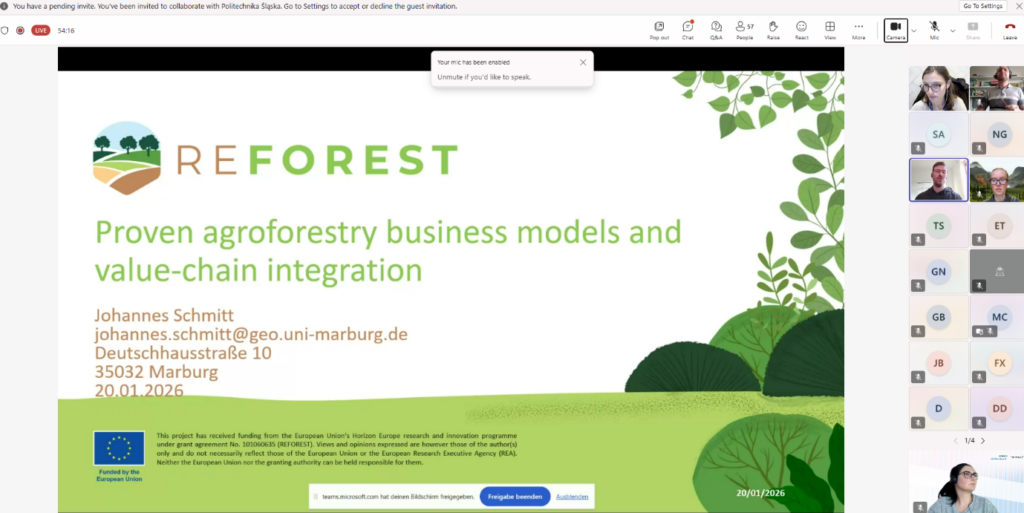
More than 60 stakeholders including researchers, advisors, civil society representatives, and practitioners from across Europe joined the ReForest webinar Agroforestry as a Viable Business. The session offered real-world insights into how agroforestry can function as a profitable and scalable land-use system. It focused on three key pillars: business models, ecosystem service valuation, and advisory frameworks.
Opening the event, Martin Lukac, ReForest project coordinator, highlighted the project’s goal of moving beyond theory to demonstrate that agroforestry can deliver measurable economic value while also supporting biodiversity, climate resilience, and broader sustainability goals.
Johannes Schmitt from the University of Marburg presented findings from 24 agroforestry case studies. These showed that agroforestry can be flexibly integrated into a wide variety of farm types and regional contexts. Rather than being treated as a standalone practice, agroforestry was framed as a tool to enhance conventional, integrated, or organic systems, tailored to farm-specific goals. The case studies revealed that farmers adopt agroforestry to diversify production, reduce input costs, and improve overall productivity, resulting in more resilient farm systems.
Tom Staton, Fellow Researcher at the University of Reading, shared an overview of the current state of advisory and knowledge-sharing systems in the sector. He highlighted key challenges facing advisors, including fragmented training, lack of formal certification, and limited cross-sector learning. He proposed a flexible, lifecycle-based advisory model supported by targeted policy and industry measures, such as advisor accreditation and peer-to-peer learning initiatives.
Albert Colom Bauza from the University of Copenhagen presented research on the added economic value of ecosystem services provided by agroforestry compared to conventional monocultures. Using data from ReForest’s Living Labs, the study quantified benefits such as carbon sequestration, improved water retention, and enhanced soil formation, factors often overlooked in traditional farm accounting. The findings showed that when these services are properly valued, agroforestry offers a more resilient and economically attractive farming model.
The webinar made it clear that agroforestry is not only ecologically beneficial for nature, farms, and society. It can also make sound economic sense. However, scaling up this potential will require:
• Integrated and adaptable business models
• Evidence-based valuation of ecosystem services
• Support ecosystem for implementation
Download presentations:
- Proven agroforestry business models and value-chain integration, Johannes Schmitt,Researcher at the University of Marburg
- Economic valuation of provisioning and regulating ecosystem services in agroforestry system compared to conventional practice with Albert Colom Bauza, Research Assistant & Bhim Bahadur Ghaley, Associate Professor at the Department of Plant and Environmental Sciences, University of Copenhagen, Denmark
- Consultancy and advisory models that support adoption and scale with Tom Staton, Fellow Researcher at the University of Reading
Access full recording of the webinar on YouTube: https://youtu.be/1g4Tw93sTM8
 Spanish
  English
  German
  French
  Danish
  Hungarian
  Czech
Czech  Bulgarian
  Dutch
Dutch