
Reflections from the ReForest UK Northern Living Lab team · Organic Research Centre · 2025
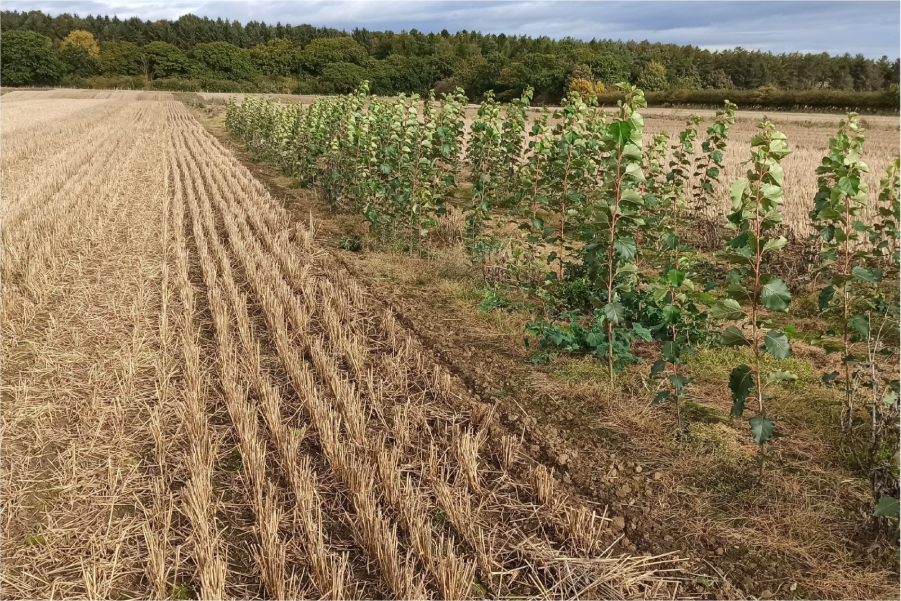
In May 2023, around twenty people gathered at Cockle Park — the University of Newcastle’s experimental farm — for the inaugural meeting of ReForest’s UK Northern Living Lab. They toured a silvo-arable system that had been established on the farm, and then, more importantly, they talked. One farmer wanted to know how to get trees established when livestock would rather eat them. Another was drawn to woodland grazing but felt tangled up in legislation. The questions were practical, specific, and very much rooted in the reality of farming in the uplands of Northern England. Three years on, it’s worth asking: what did the Living Lab actually do with them?
A network, not a single site.
The UK Northern Living Lab took a deliberately different approach from many of its ReForest counterparts. Rather than anchoring the work to a single agroforestry demonstration site, the team at the Organic Research Centre set out to build something more distributed: a network linking experienced agroforesters with farmers who were just beginning to explore what trees might mean for their land and their business.
That meant getting out into the field — literally. Farm visits were organised at Gowbarrow Hall Farm and Sleastonhow Farm in Cumbria. At Gowbarrow, twenty people gathered for a grounded conversation about integrating livestock farming with existing woodland and in-field trees. At Sleastonhow, thirty or so farmers came for something more hands-on: a practical training session on sweet chestnut coppicing, exploring how a farm can generate fencing materials and an additional revenue stream from its trees. Touring the farm broadened horizons across the whole range of options for weaving trees into a farm business.
A bi-monthly newsletter kept over fifty subscribers connected between events, sharing developments and opportunities for involvement. Two online training sessions on upland silvopasture extended the reach further. And the team was a visible presence across the farming calendar — at the Agroforestry Open Weekends of 2023, 2024, and 2025, the Agroforestry Shows, and regenerative farming conferences including Groundswell, Carbon Calling, and Cultivating Wisdom.
“It was the most enjoyable farmer event she had attended — and there was so little on offer about agroforestry in her region of the North West.”
Designing together
The most impactful strand of the Living Lab’s work was probably its series of three co-design workshops, each creating space for farmers who wanted to establish new agroforestry schemes to share their needs and ambitions with more experienced members of the network — and receive practical, specific suggestions in return.
Each workshop took a different form, and each revealed something useful about how this kind of knowledge exchange works best. An online session with seventeen attendees was low-cost, accessible, and generated a constructive plan. An in-person workshop at the Agroforestry Show in September 2025, attended by twenty-four people, harnessed the energy of a larger gathering and connected with additional activities in the ReForest Training Hub. The third workshop, held on-farm, was less well attended — ten people, on a dry day after months of rain — but it enabled deeper conversation, more specific design work, and the kind of relationship-building that only comes from sharing a landscape together.
All three formats had their place. The lesson is less that one mode is superior and more that farmers engage in different ways, and a Living Lab that offers only one format will reach only part of its potential audience.
Data, models, and tools
Alongside the engagement work, the Living Lab contributed to the development and testing of the tools and models that sit at the heart of the ReForest project’s ambitions for scaling agroforestry. Fieldwork at Gibside — a Community Supported Agriculture enterprise near Newcastle — involved soil sampling, tree measurements, and plant quadrats. Financial and operational data collected from Cockle Park fed into financial modelling led by ReForest partners. The FarmTree model was parameterised for Cockle Park and the results presented in a training webinar, while the Public Goods Tool was applied to another farm in the region.
“The FarmTree model was parameterised for Cockle Park — grounding one of ReForest’s key tools in the reality of a Northern English farm.”
What has taken root
Impact in a living lab is always difficult to measure cleanly, and honesty about that matters. But some outcomes are concrete. Two of the Living Labs have entered into a new funded collaboration to exchange knowledge on fruit-based agroforestry in upland systems. Consultancy work with another farmer has followed for the research team. And with some promising government grants for on-farm tree planting appearing on the horizon, the momentum the Living Lab has helped build feels timely.
Perhaps the most telling indicator, though, is simpler than any of that: the remark from one participant that it was the most enjoyable farmer event she had attended, and that there was almost nothing else on offer about agroforestry in her part of the North West. In a region where the agroforestry conversation is still finding its footing, creating a space where farmers feel that engaged and that well-served is no small thing.
The questions that were asked at Cockle Park in May 2023 — how do you protect young trees from livestock, how do you navigate the legislation around woodland grazing — haven’t all been answered. But more people are now working on them together than were before. That, in the end, is what a network is for.
“Seeds have definitely been sown which we trust will grow into mature and productive agroforestry systems in the future.”
This blog article is developed as a result of the co-creation work with Living Labs coordinated by EMEA with the support of Project partners and living Lab leaders.
 Czech
Czech  English
  German
  French
  Spanish
  Danish
  Hungarian
  Bulgarian
  Dutch
Dutch