
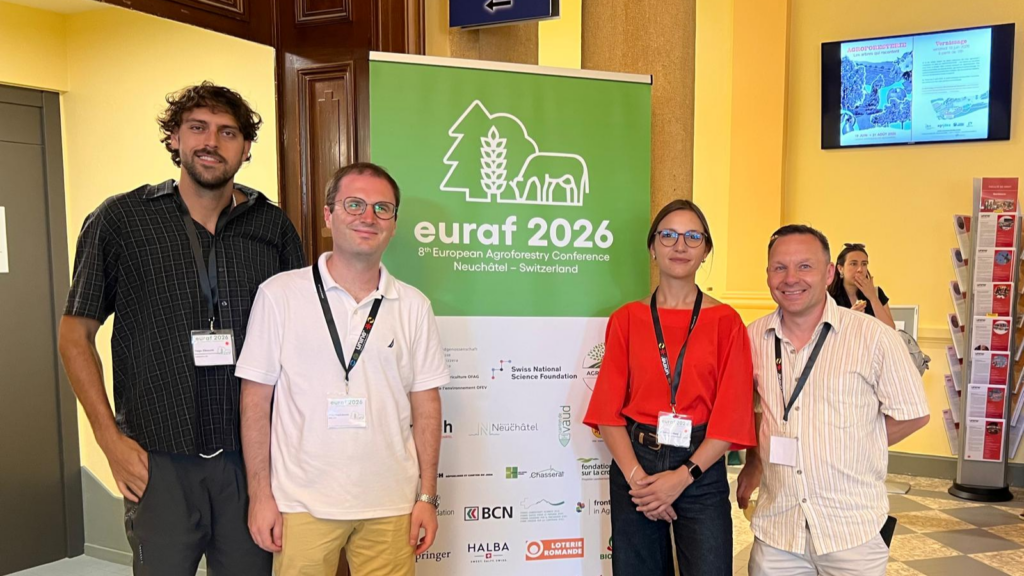
From 22 to 26 June 2026, the ReForest project joined the European agroforestry community in Neuchâtel, Switzerland, for the 8th European Agroforestry Conference, EURAF 2026. The conference brought together scientists, farmers and policymakers to exchange knowledge and advance agroforestry practice across Europe. Some of the major topics of the event were agroforestry for food security in a changing world, farmer-friendly agroforestry, reconciling agriculture and nature, and agroforestry systems design.
A central part of ReForest’s participation was linked to hands-on digital tools for agroforestry planning and assessment. The workshop on Hands-on demonstrations of agroforestry tools for system design, financial costs and benefits evaluation, biodiversity impact, carbon storage and other environmental assessments was designed as an interactive session where participants could explore tools developed within DigitAF, ReForest and other initiatives. The session highlighted the importance of decision-support, spatial planning, economic, biodiversity and carbon assessment tools, and invited participants to engage directly with developers and provide feedback from the perspective of farmers, policymakers, value-chain actors and other users.
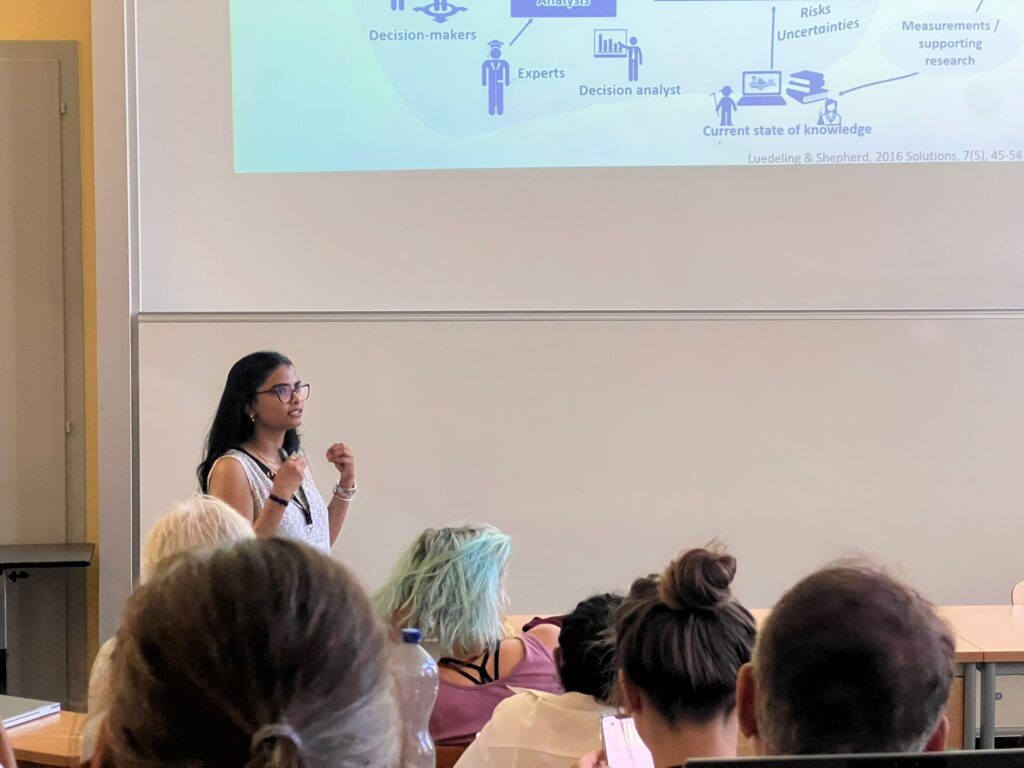
ReForest contributions to this tools-focused discussion included work on dynamic agroforestry management and decision analysis. The Dynamic Management Tool presented by ReForest partners applies decision analysis to support farm-level decisions under uncertainty and includes examples such as apple agroforestry in Germany, silvopastoral designs in the UK, walnut alley-cropping and hedges in Belgium, and fruit-and-honey production systems.
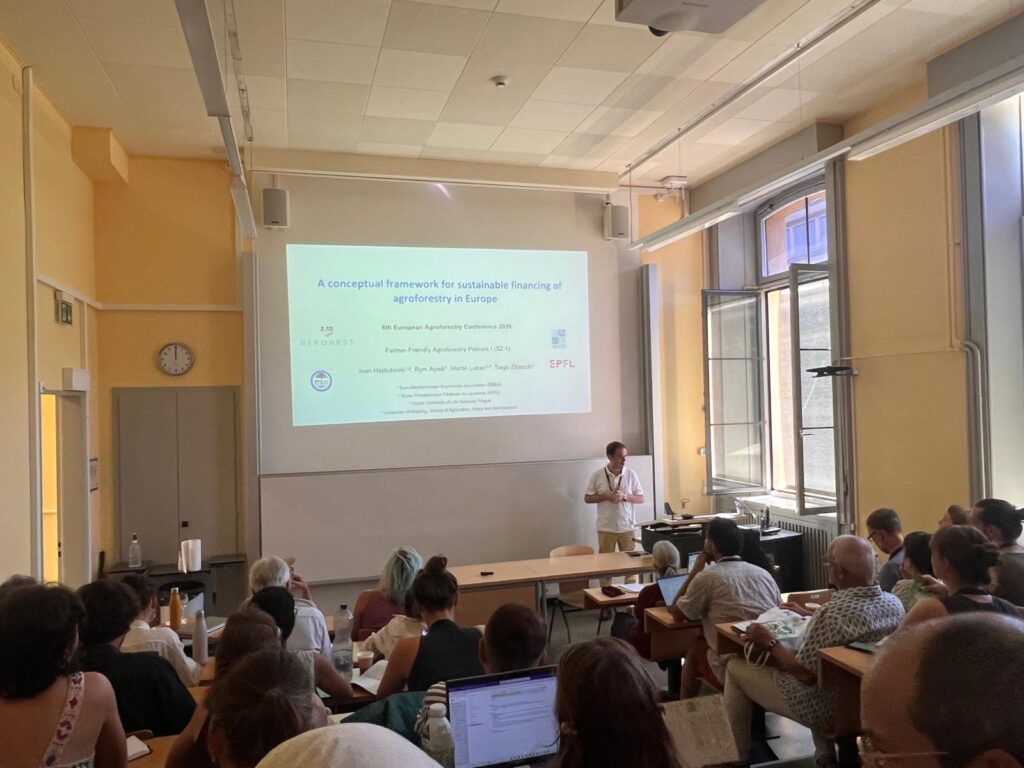
ReForest also contributed to discussions on farmer-friendly agroforestry policies and finance. The EURAF session on Farmer friendly agroforestry policies focused on the limited uptake of agroforestry by farmers and explored how policy, education, training and administration can be adapted to better match farmers’ realities. ReForest presented the work done within the project on structured financing frameworks, policy and regulatory gaps, funding and investment gaps, and knowledge and data gaps. The proposed financing approach includes ex-ante payments, action-based payments, hybrid results-based payments, advisory services, and de-risking or blended finance mechanisms.
Another important ReForest contribution addressed financial performance, uncertainty and risk in agroforestry systems. The work by UCPH partners compared two organic agroforestry systems with conventional monoculture under normal and climate-change scenarios. The study found that, in the absence of external risk, the agroforestry systems outperformed conventional monoculture by 11% in the short-rotation coppice system and 20% in the apple agroforestry system. Under the climate-change risk scenario, profits in conventional monoculture declined by 33%, while agroforestry profits declined by 12%, pointing to the stabilising role of diversification.
ReForest partners also presented their work on economic evaluation of agronomic productivity and ecosystem services comparing agroforestry systems with monoculture practices and concluded that agroforestry belts recorded the highest provisioning and regulating ecosystem-service values. The results support the case for recognising agroforestry’s multifunctional role and for rewarding farmers through CAP subsidies and payments for ecosystem services.
The project’s work on carbon accounting and operational emissions was represented through the “Operational Carbon Footprint of an Organic Agroforestry System in Denmark.” ReForest also contributed evidence on agroforestry value chains and business models. The value-chain research within the project show that agroforestry products must compete with conventional markets and that the added value generated by agroforestry should primarily benefit producers. The analysis combined farm-level testing of agroforestry products, assessment of agroforestry farming systems at EU level, and value-chain analysis based on ReForest Living Labs.
Across these various contributions, ReForest showed how scientific evidence, Living Lab experience and practical decision-support tools can help make agroforestry more understandable, assessable and implementable. The project’s presence at EURAF 2026 supported sharing project results with farmers, advisers, researchers, policymakers and value-chain actors through events, tools, scientific outputs and stakeholder engagement.
By bringing together evidence on productivity, ecosystem services, finance, carbon, biodiversity, advisory systems and value chains, ReForest contributed to the wider EURAF 2026 discussion on how agroforestry can be scaled in ways that are environmentally sound, economically viable and farmer-friendly.
We would also like to warmly thank EURAF for highlighting the ReForest Platform in the conference follow-up communication and for encouraging participants to continue the conversation, networking and knowledge exchange through it.
All ReForest posters and presentations from the conference are available here.
 Hungarian
  English
  German
  French
  Spanish
  Danish
  Czech
Czech  Bulgarian
  Dutch
Dutch