
An interview with researchers at Inagro · Reforest Project, 2026
Two years ago, at the very start of the ReForest project, we spoke with the team at Inagro as they were establishing their agroforestry living lab in Flanders — an ambitious experiment set in one of Europe’s most intensive conventional farming regions. Back then, the focus was on design choices, early expectations, and the challenges of introducing trees into high-value cropping systems.
Today, the system is still young, but no longer theoretical. The first seasons of data have been collected, unexpected challenges — particularly around water management — have reshaped the plot, and early insights into biodiversity, farmer engagement, and economic realities are beginning to emerge.
In this follow-up conversation, we return to the Belgian ReForest Living Lab to understand what has changed since those early days: what worked, what didn’t, and what lessons are already taking root for the future of agroforestry in Flanders.
In the heart of Flanders, on a 1.4-hectare plot of sandy loam, Inagro has been quietly building something unusual: an agroforestry system in one of Europe’s most intensive conventional farming regions. We spoke with the team behind the Belgian Reforest Living Lab about flooded fields, skeptical farmers, growing walnut trees, and why the most important harvest is still years away.
It’s been a couple of years since the living lab was set up. What have been the most important developments so far?
We’re still in a very young phase, so tree-crop interaction lessons are limited. The trees simply haven’t grown large enough to significantly affect the crops yet. What we have achieved is getting a comprehensive sensor-based monitoring system fully operational — which means this plot will keep generating valuable data long after the project ends.
That said, keeping all the sensors running has been a real challenge. It requires weekly checks, and managing the growing number of data streams — linking them, storing them, and visualising them in a way that’s actually useful for farmers — has been harder than expected.
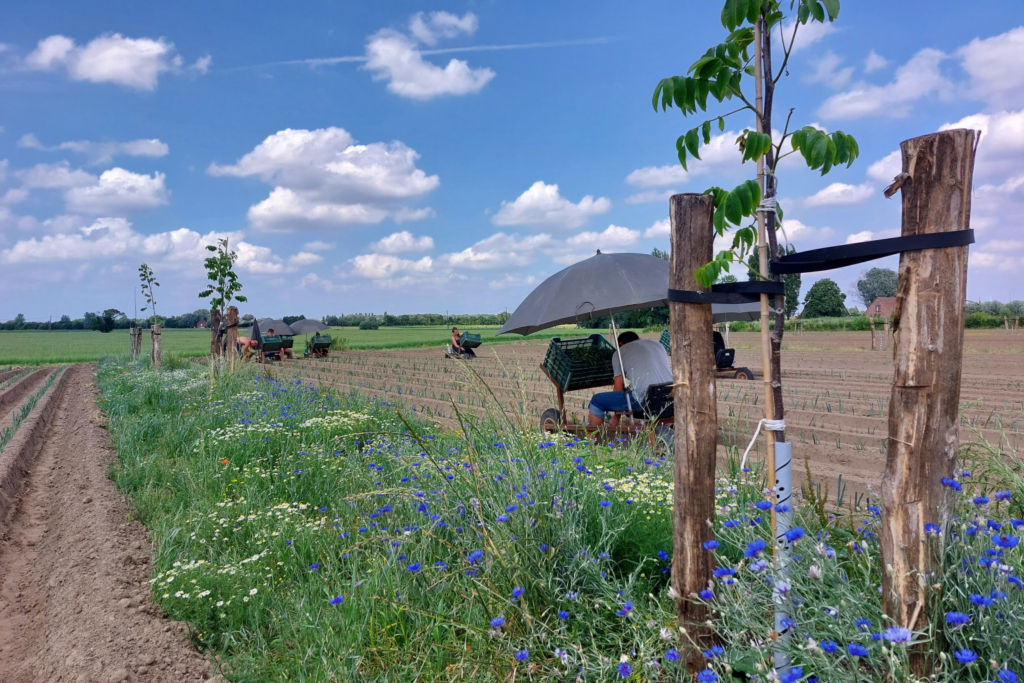
We’ve also broadened our biodiversity work. Beyond the flower strips, we’ve added hedges for nesting partridges, steep soil banks for wild bees, and additional pollinator strips on surrounding parcels. And the plot has been included as a test case in the LIFE project AFaktive, which focuses specifically on agroforestry and water management.
How have the walnut trees and intercrops developed — and what interactions are you seeing?
The trees are growing steadily. Most show healthy leaf emergence and early flowering, which is a promising sign for future nut production. We’re already removing young walnuts to encourage vegetative growth — our first significant harvest is probably still five years away.
We’ve had three monitored cropping seasons: leek, ryegrass, and winter wheat. So far, the young trees have had virtually no negative impact on yields. The main economic effect is simply the land the tree rows occupy. For leek — a high-value crop — this was particularly noticeable, with harvest logistics causing an additional 5% loss of usable area on top of the tree rows themselves.
“The most significant influence at this point is the loss of cropping area due to the tree rows — not competition for light, water, or nutrients.”
Water management wasn’t a major theme in the original case study. What happened?
It turned out to be our biggest challenge — far more demanding than managing the trees or the intercrops. We had periods of severe rainfall and standing water that made the field inaccessible and forced us to cancel planned crops. Maize had to be abandoned entirely and replaced with ryegrass as an emergency measure just to keep the soil covered.
We eventually brought together experts in hydrology, soil science, crops, and trees to work through solutions. Two tree rows were replanted on slightly raised ridges — which also double as beetle banks — and drainage works were improved toward the adjacent stream. Some walnut trees were lost to waterlogging before these interventions were complete.
It was extremely frustrating at the time, but it’s generated lessons we couldn’t have planned for. Water-related challenges are becoming more critical across our region, and we hope our experience helps other agroforestry farmers think carefully about water management from the very beginning of their design process.
What about biodiversity — have the flower strips made a measurable difference?
Three years of monitoring confirm that the flower strips and grass-herb strips beneath the trees attract a wide range of beneficial insects and provide food, shelter, and overwintering habitat. The presence of insects is clearly established.
However, there’s a complication: fertiliser applied to the intercrops has repeatedly spilled onto the tree strips, causing flowering species to die back. What started as flower strips have gradually become grass strips. They’re still valuable — tussocky grasses provide excellent habitat for ground beetles, which are important for natural pest control — but we haven’t yet been able to quantify the direct impact of these insects on crop performance or tree health.
You set out to prove that agroforestry can work in conventional farming. Have farmers’ attitudes shifted?
Progress is slow. Farmers understand intellectually that trees and biodiversity matter, but they struggle to see how trees contribute to their income. In Flanders, where land prices are very high, planting trees feels like giving up productive ground — and it’s hard to argue against that when the financial returns are still years away.
We haven’t formally surveyed visiting farmers, so we can’t say definitively whether perceptions have changed. What we can say is that the conversation is happening. We’ve regularly brought farmers and other stakeholders onto the field to share concerns and ideas, and that dialogue itself has been valuable — it keeps our system relevant to the region and ensures we’re asking the right questions.
“The way forward is to show and prove to farmers that woody elements can be part of a business model. So far, we have no numbers from our young living lab to support this — but we expect that to change.”
What’s the economic picture looking like?
We’ve collected detailed data on planting costs and ongoing management expenses. The honest summary is this: we’re currently in a phase of additional costs with no additional income. The trees don’t yet produce revenue. The intercrops generate slightly less income because of the area the trees occupy. Unforeseen interventions — particularly around water management — have added further unplanned costs.
None of this is surprising for a young perennial system, but it’s a reality farmers need to factor in from day one. An agroforestry plot is unlikely to function optimally in year one, and a financial buffer for unexpected challenges is essential.
What do you consider the biggest success of the living lab so far?
Probably the flexibility the model gives us. Because Inagro owns and manages the plot ourselves, we’re not financially dependent on the agroforestry system performing well — which means we can take risks, try new approaches, and absorb setbacks without putting a farmer’s livelihood on the line. That’s quite different from most living lab setups.
Another highlight has been the growing interest from agricultural schools. Students — our future farmers — have visited multiple times to learn about agro-ecological practices. We think this kind of early exposure is one of the most important long-term levers for agroforestry adoption in Flanders.
And working closely with in-house crop specialists who had no prior agroforestry experience has been genuinely productive. They’ve helped us anticipate crop-specific challenges, and in return they’ve come to understand the system in a way that will improve their advice to farmers going forward.
What comes next — both for the plot and for sharing what you’ve learned?
The plot will continue operating as a space for knowledge exchange and stakeholder visits. We’ve joined a new Flemish project — VLAIO Pro-Noot — focused on professionalising walnut cultivation in Flanders, where our experimental field is now included. Pest and disease management in walnut plantations is an increasingly pressing issue, and we’re well placed to study it.
In terms of outreach, our main priority is continuing the newsletter series we’ve developed — detailed, data-backed communications explaining our design choices, monitoring methods, management decisions, and lessons learned. Farmers respond to concrete numbers and real examples. As the system matures and the economics become clearer, we’ll have more to say.
And staying connected to EU and national research networks remains important. Being part of Reforest has strengthened our monitoring capabilities and helped our data feed into wider European models. We want to keep contributing at that scale.
This blog article is developed as a result of the co-creation work with Living Labs coordinated by EMEA with the support of Project partners and living Lab leaders
 Spanish
  English
  German
  French
  Danish
  Hungarian
  Czech
Czech  Bulgarian
  Dutch
Dutch