
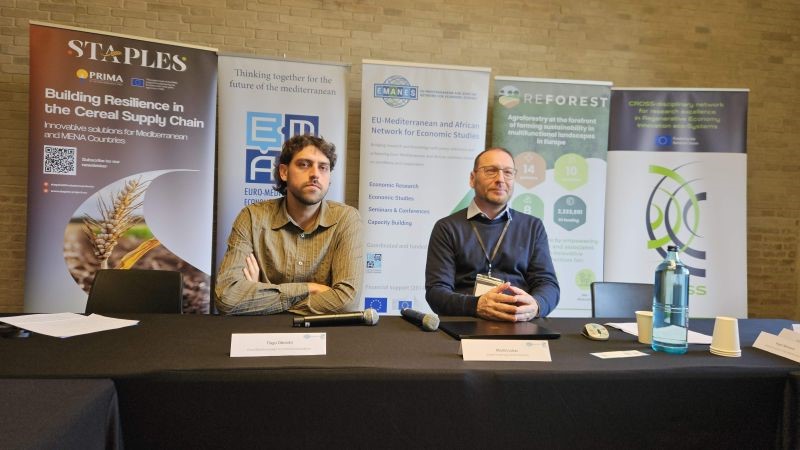
On 12 December 2025, ReForest project hosted a Special Session on “Regenerative Finance Scheme for Agroforestry Upscaling” during the EMANES Annual Conference 2025 in Barcelona. The session took place at the Euro-Mediterranean Economists Association (EMEA) headquarters in the historic Recinte Modernista de Sant Pau, bringing together researchers, financial experts, policymakers, and practitioners engaged in building more resilient land-use systems and was broadcasted live.
Moderated by Prof. Martin Lukac, ReForest coordinator, the session explored the structural, economic, and policy conditions required to accelerate agroforestry adoption across Europe. Based on the research conducted under the project, the event reaffirmed the deep connection between economy and environment, revealing a major opportunity to shape economic systems that regenerate ecosystems while strengthening rural economies.
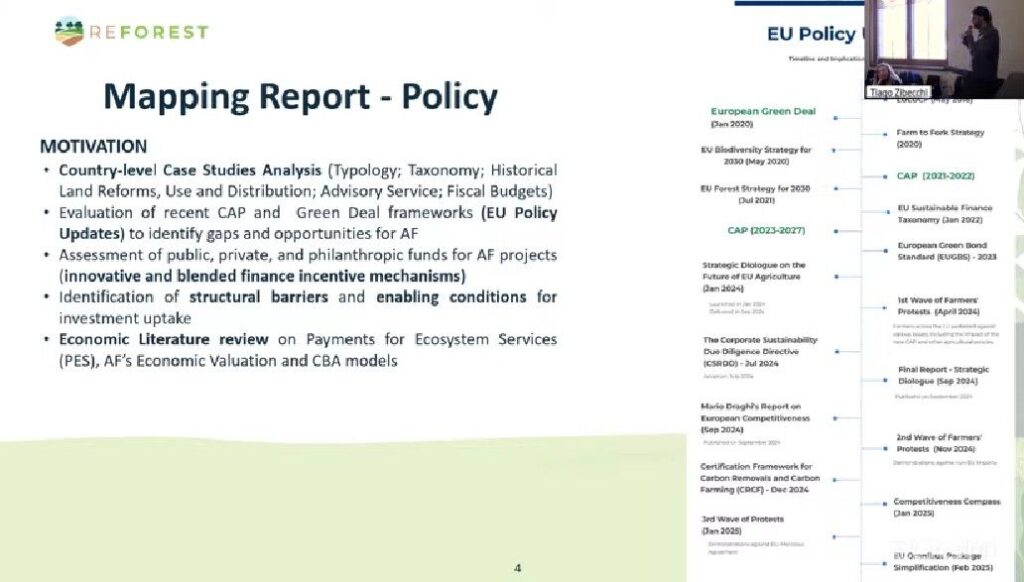
Dr. Prajna Kasargodu Anebagilu (University of Bonn) presented the institutional barriers hindering agroforestry adoption across 11 EU countries. The analysis demonstrated that, although agroforestry’s benefits for soil health, biodiversity, carbon sequestration, and farm resilience are widely recognised, adoption remains limited due to:
- restrictive or inconsistent CAP and forestry regulations, including uniform tree-density caps, static canopy thresholds, and complex land-code classifications;
- high upfront establishment costs and delayed returns, which are difficult for farmers to absorb;
- gaps in financial incentives, where existing schemes fail to cover full system costs;
- limited advisory services and a lack of specialist knowledge in regional administrations;
- insufficient market access and value-chain infrastructure for agroforestry products.
These findings are reinforced by insights from ReForest’s Living Labs, where both workshop feedback and farmer surveys confirm persistent financing gaps, incomplete advisory coverage, and challenges in creating viable long-term business models.
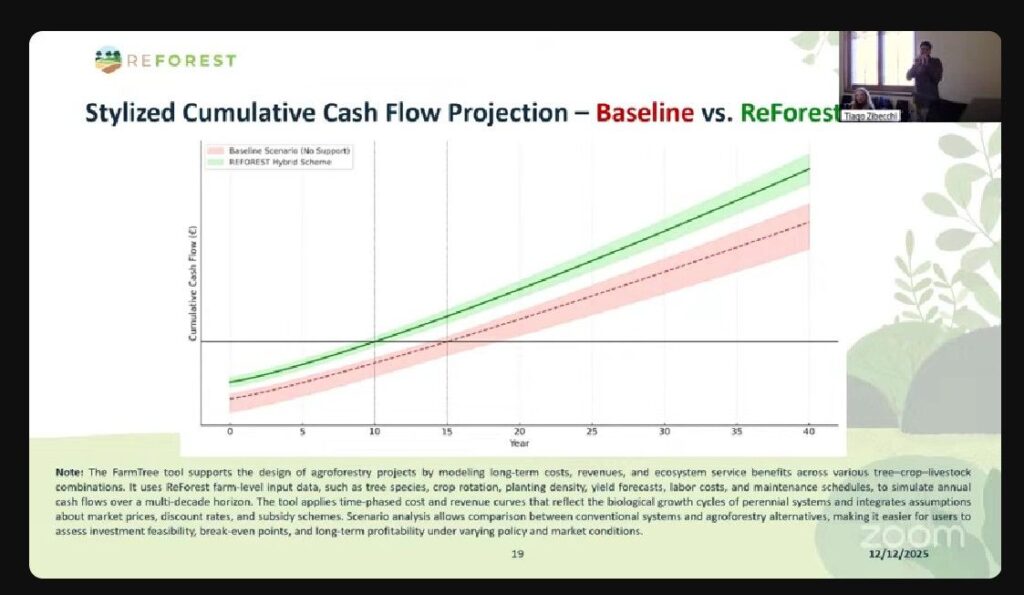
Dr. Anebagilu also introduced the Dynamic Management Tool, a probabilistic, farmer-centred decision-support model that tests agroforestry system performance under uncertainty. By modelling systems using real data from Living Labs in Germany, Belgium, and the UK, the tool demonstrates how different funding structures dramatically shape long-term viability.
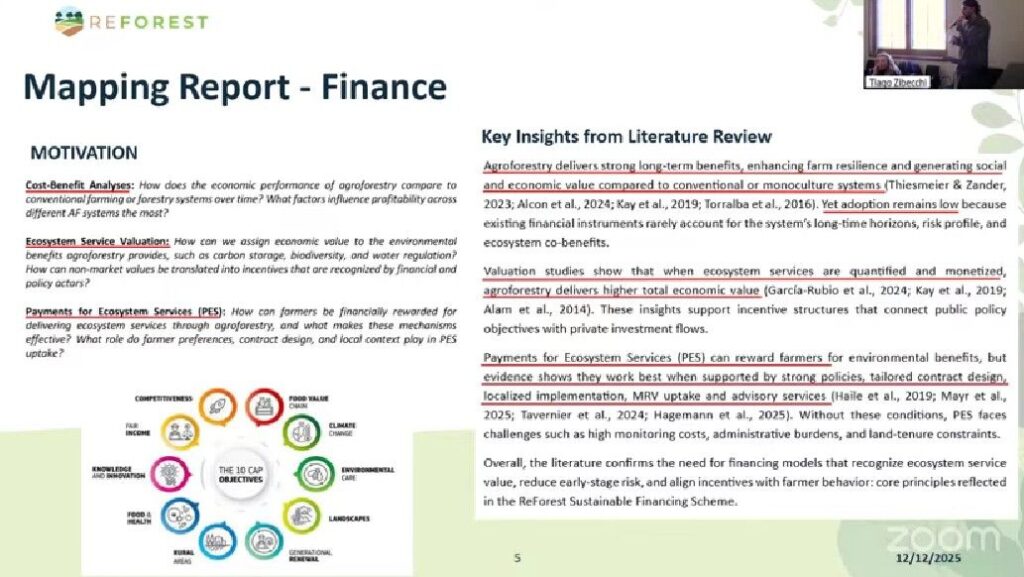
Another important contribution was designing a regenerative finance scheme for scaling agroforestry.
Tiago Fioravanti Zibecchi (EMEA) presented the project’s proposed Regenerative Finance Scheme, which aims to fill critical gaps in EU and national financing structures.
A forthcoming ReForest research paper will further quantify the scheme’s impact using the Dynamic Management Tool.
The session demonstrated how agroforestry can serve as a cornerstone of regenerative rural development, delivering food production, carbon capture, biodiversity gains, and climate resilience while strengthening local economies.
The ReForest project continues to work across research, co-creation, and finance innovation to enable a transition toward scalable, economically viable agroforestry in Europe and associated countries.
Download presentations:
Finance Scheme for upscaling Regenerative Agroforestry
Agroforestry adoption in Europe. Institutional Barriers, Incentives
Full recording: https://www.youtube.com/watch?v=mu03mHeinUg
 Spanish
  English
  German
  French
  Danish
  Hungarian
  Czech
Czech  Bulgarian
  Dutch
Dutch