An interview with Balázs Kulcsár, Valaha Tanya Farm · Reforest Project, 2025
Two years ago, at the very start of the ReForest project, we visited Valaha Tanya — a 12-hectare organic farm above Lake Velence in Hungary, built from scratch by Balázs Kulcsár and his wife on land that had spent decades under intensive chemical agriculture. The farm had already grown into something remarkable: a layered system of orchards, wooded pastures, shelterbelts, and wild fruit plantations, woven together with livestock and guided by a combination of agroforestry, permaculture, and organic principles. Today, the farm continues to evolve — responding to a climate that has shifted dramatically over twenty years, a policy landscape that hasn’t kept pace with diverse farming systems, and a set of ecological results that are quietly remarkable. In this follow-up conversation, we return to Vértesacsa to hear what has changed, what has been confirmed, and what Kulcsár still hopes to see recognised.
You started farming this land in 2006, commuting 50 km a day with no local connections and soil that had been stripped of life by decades of chemical use. What did those early years actually look like?
We were starting from almost nothing — no local network, no equipment, commuting every day, which made timing every operation a serious problem. The soil had been under intensive chemical monoculture for around fifty years. Soil life had been degraded to near zero, and even the weeds had been suppressed by chemicals rather than outcompeted by anything healthy.
Our first priority was to stop disturbing the soil. We built up a minimal set of machinery capable of the necessary mechanical operations, and then established a continuous green cover across the whole area. The idea was simple: stop depleting the soil seed bank and let life begin to return on its own terms.
The farm combines agroforestry, permaculture, and organic farming. In practice, how do these three approaches fit together — do they ever pull in different directions?
They operate at different levels, which is why they complement rather than conflict. Organic farming defines the framework — what’s permitted, what isn’t. Permaculture provides the ethical foundation and the methodology for designing the whole system, with particular emphasis on perennial woody plants. Agroforestry then provides the practical methodology for how the cultivation system actually functions day to day.
Each gives the others something they couldn’t provide alone. Permaculture without production discipline risks becoming purely theoretical. Organic farming without a systems-level design can still lead to simplistic monocultures. Agroforestry without an ethical and ecological framework becomes just another production technique.
The farm is surrounded by large-scale intensive operations. How do you manage the chemical drift coming from neighbouring fields?
We’ve established an ecological buffer zone around the entire farm — a combination of grassland and field hedges that runs along the farm’s perimeter. This does two things simultaneously: it increases the physical distance between our crops and the neighbouring fields, and it creates a barrier that intercepts drift before it reaches our plantings. The hedges that form this buffer also serve as shelterbelts, which helps with the wind and drought challenges we face on this exposed site.
“Precipitation on our farm has dropped from 600mm to 300mm over twenty years. Raspberry cultivation has almost ceased — but quince is producing wonderful results.”
The climate on your farm has changed significantly over the twenty years you’ve been working the land. What are you seeing, and how has it changed what you grow?
The change has been dramatic and measurable. Sunshine hours and maximum summer temperatures have increased substantially, while annual precipitation has dropped from around 600mm to roughly 300mm. That’s a halving of rainfall in two decades — a profound shift for any farming system to absorb.
Some crops that once thrived here have become almost unworkable. Raspberry cultivation has all but ceased. But other species are responding positively to the warmer, drier conditions — quince in particular is producing excellent results. We’re actively experimenting with fruit-bearing species and varieties that can deliver competitive yields without irrigation, because the assumption that water will be available when needed is no longer reliable.
The farm integrates goats, cattle, poultry, horses, and donkeys alongside the trees and crops. What role do the animals play in the overall system?
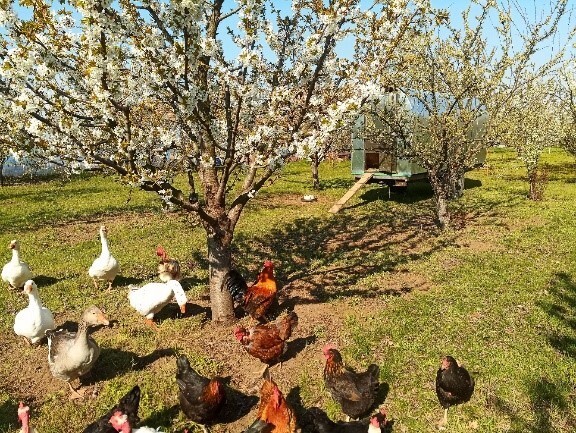
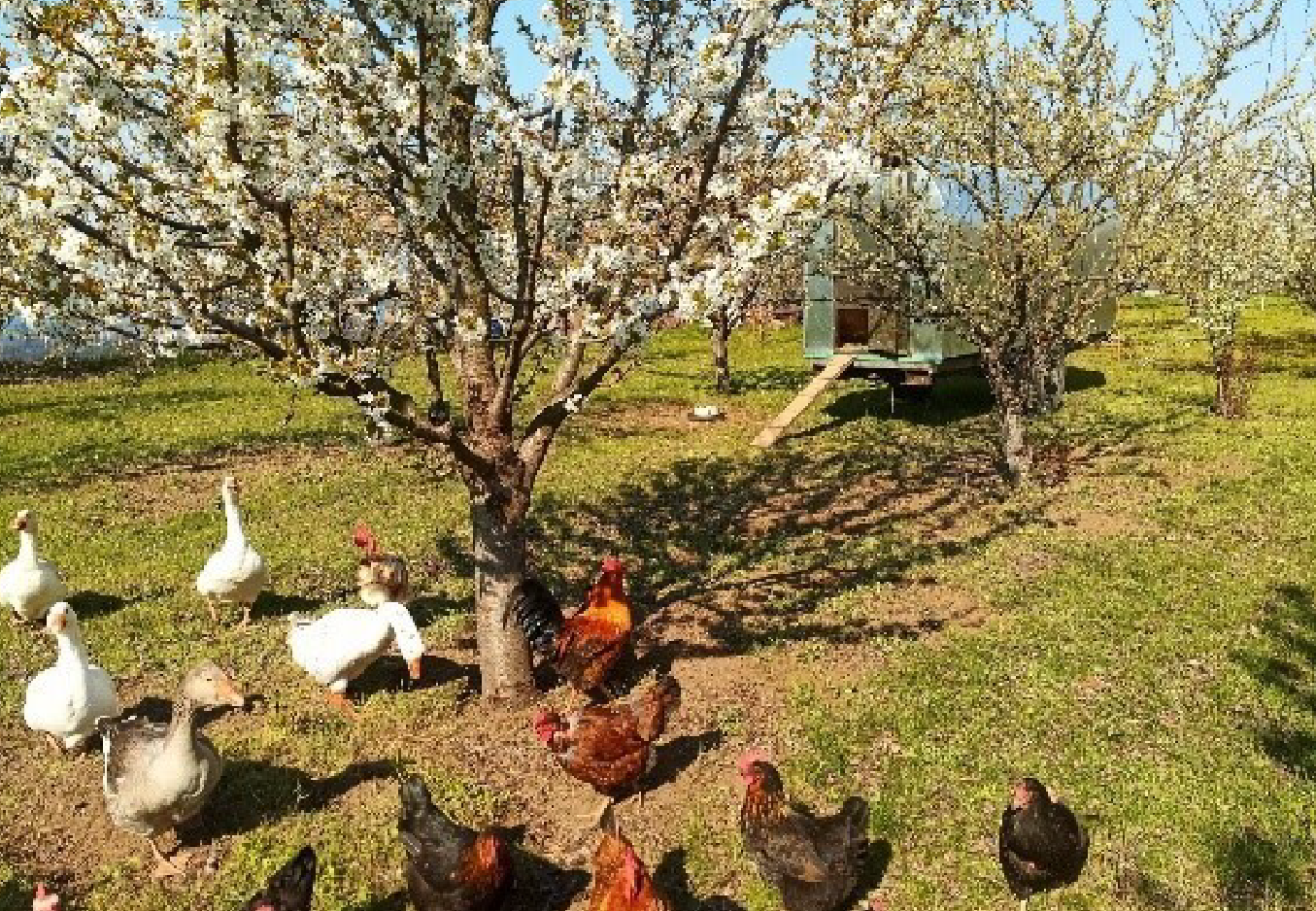
The animals are central to the farm’s circular economy. Poultry work through the orchards and significantly reduce pest pressure. Ungulates — the goats, cattle, horses, and donkeys — consume grasses and fruit-processing waste that would otherwise need to be managed separately. The manure from all the animals is composted and returned to the land to support plant health.
Each element feeds the others. The trees provide shade and fodder. The animals manage vegetation and generate fertility. The crops benefit from both. Removing any one element would reduce the efficiency and resilience of the whole.
What are you seeing in terms of biodiversity and soil health — is there measurable evidence of change after nearly twenty years of this approach?
The biodiversity results have been striking. Soil microarthropod diversity — the tiny organisms that are a reliable indicator of soil biological health — is highest in the orchard strips, with strong values also recorded along the grassy orchard edges. Several taxa, including Pseudoscorpionida, Diplopoda, and Isopoda, were found exclusively in the orchard soil. Other rare groups, such as Symphyla and Chilopoda, appeared not just in the orchard but in the grassy edges and grasslands too.
On the soil health side, the complete absence of fungicides — even those permitted in organic farming — has allowed edible mushrooms to establish across the farm. They now represent genuine economic value, which is something we didn’t anticipate when we started. It’s a small but telling sign of how a soil ecosystem, once given the chance, can build its own complexity.
“Edible mushrooms found across the farm now represent real economic value — something we didn’t anticipate when we started. It’s a sign of what a recovering soil ecosystem can do.”
Has being part of the ReForest network made a difference to how you work?
Joining ReForest has been most valuable in two areas: knowledge sharing with other practitioners working in different contexts, and the scientific measurement and quantification of what we’ve been doing. For a farm like ours — built on practical experience and observation over many years — having rigorous methods for documenting results is genuinely useful. It makes the case for this approach in conversations where anecdote isn’t enough.
Looking ahead, what are your priorities for Valaha Tanya — and what would you need from policy to support them?
On the farm itself, we’ll continue refining our cultivation and maintenance methods and testing new species and varieties suited to the drier conditions we’re now experiencing. The goal is a productive orchard system that doesn’t depend on irrigation — which feels increasingly important as water availability becomes less predictable across the region.
On the policy side, the gaps are significant. Agroecological incentives in the CAP currently focus almost entirely on arable land — they don’t adequately cover the kinds of diverse, perennial systems we operate. And the funding that does exist for agroforestry tends to support the establishment of new systems rather than the maintenance of existing ones. That’s a problem, because established, functioning systems like ours carry enormous biodiversity and habitat value that simply disappears if they aren’t supported over time. The system we’ve built over twenty years can’t be recreated quickly — but it can be lost quickly if the economics don’t work.This blog article is developed as a result of the co-creation work with Living Labs coordinated by EMEA with the support of Project partners and living Lab leaders.
 German
  English
  French
  Spanish
  Danish
  Hungarian
  Czech
Czech  Bulgarian
  Dutch
Dutch