
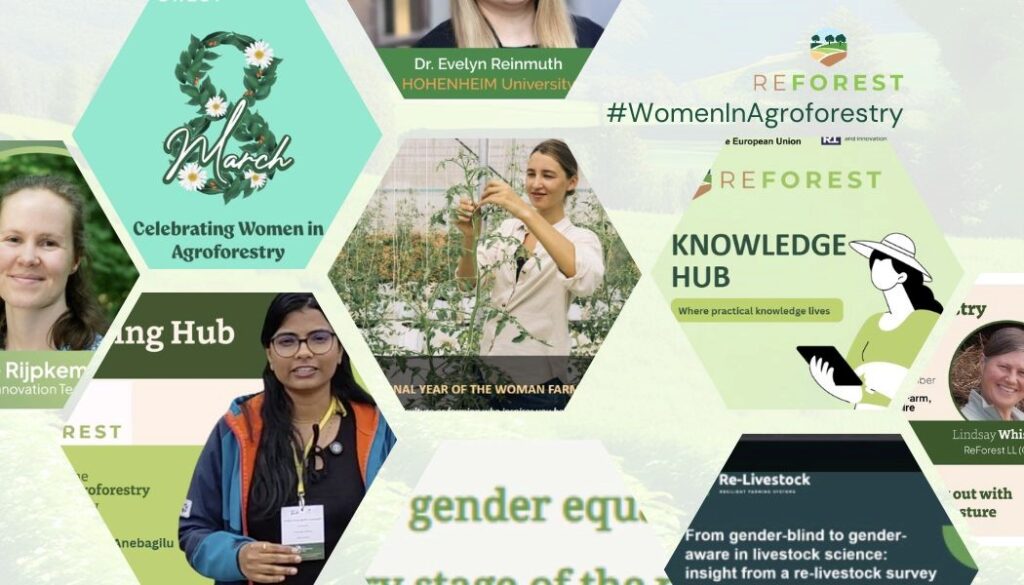
Agroforestry is often described through its environmental and economic benefits. However, in the ReForest project experience, one message has become increasingly clear and it is that agroforestry is also, fundamentally, about people, who participate in innovation processes, who need access to reliable knowledge materials and tools, who is represented in decision-making, and whose practical experience shapes the future of farming.
This is why gender has been an important cross-cutting topic for ReForest although it is not a main research area of the project. Across Europe, women remain underrepresented in farm management. According to the European Commission data, women led only about 31% of EU farms in 2023, confirming that agriculture remains a sector where gender gaps persist. Globally, FAO also highlights that women play a vital role in agrifood systems while often facing barriers linked to land tenure, finance, technical support, services and education. This This wider context was echoed in many events and discussions on the topic, where we took part.
For agroforestry, these barriers matter in a specific way. Agroforestry adoption often requires long-term access to land, advisory support, investment capacity, technical knowledge and confidence in new business models; when women have less access to these resources, their ability to participate in agroforestry innovation may also be limited.
ReForest was built around co-creation, Living Labs and knowledge exchange. As the project progressed, gender equality became part of this wider reflection on participation and representation and data on it was collected throughout the project. Although it is clear that farming, forestry and agroforestry are traditionally male-dominated sectors, gender imbalances can appear not only in practice, but also in research, leadership and decision-making.
Understanding such imbalances is a first step towards considering gender relevance in research where applicable, monitoring gender balance where meaningful, supporting women’s access to knowledge and innovation, and increasing the visibility of women farmers, practitioners and researchers. One important lesson from ReForest is that gender equality starts with visibility. Across the project, partners collected gender-disaggregated information for activities such as Living Lab meetings, stakeholder meetings, interviews, surveys, workshops, field visits, farmer training activities and educational events. In parallel, ReForest used its communication channels to highlight women in agroforestry, gender-aware research, women’s participation in farm management and the importance of inclusive access to knowledge and decision-making.
By making issues on women participation in agroforestry more visible, ReForest contributed to a broader message: women are not only beneficiaries of agricultural innovation, but also farmers, researchers, advisers, entrepreneurs, land managers, knowledge holders and leaders in the agroforestry transition.
Although that the project did not solve all structural inequalities in agriculture and agroforestry, including within research and innovation processes but it helped make them more visible within research, co-creation, communication and monitoring. It became clear that sustainable agroforestry needs more than technical solutions. It needs inclusive participation, accessible knowledge, fair representation and diverse leadership. It needs women’s experience to be visible in research, practice, advisory services and rural innovation.
As ReForest closes, one of its important messages is clear: the future of agroforestry in Europe should be productive, biodiverse, climate-resilient — and inclusive.
ReForest invites farmers, practitioners, researchers and rural stakeholders to continue using the project’s Knowledge Hub and platform resources, and to keep sharing examples that make women’s contributions to agroforestry more visible.
 German
  English
  French
  Spanish
  Danish
  Hungarian
  Czech
Czech  Bulgarian
  Dutch
Dutch