
An interview with researchers at the University of Sopron · Reforest Project, 2025
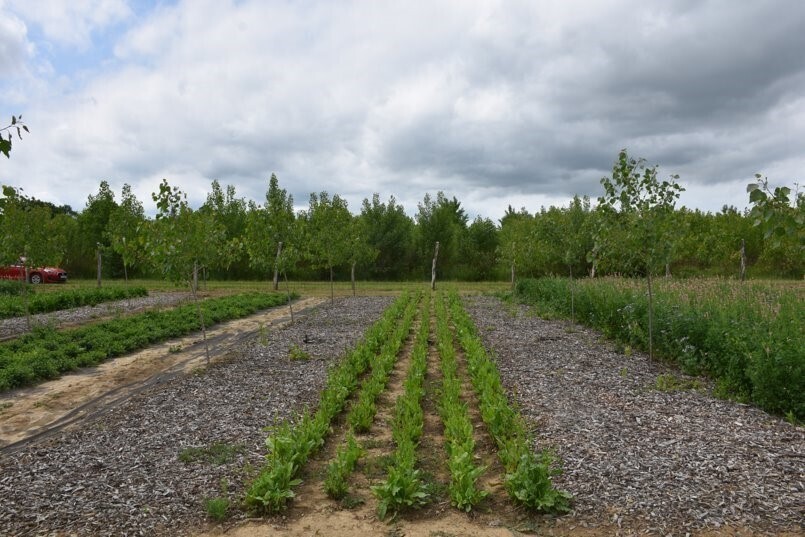
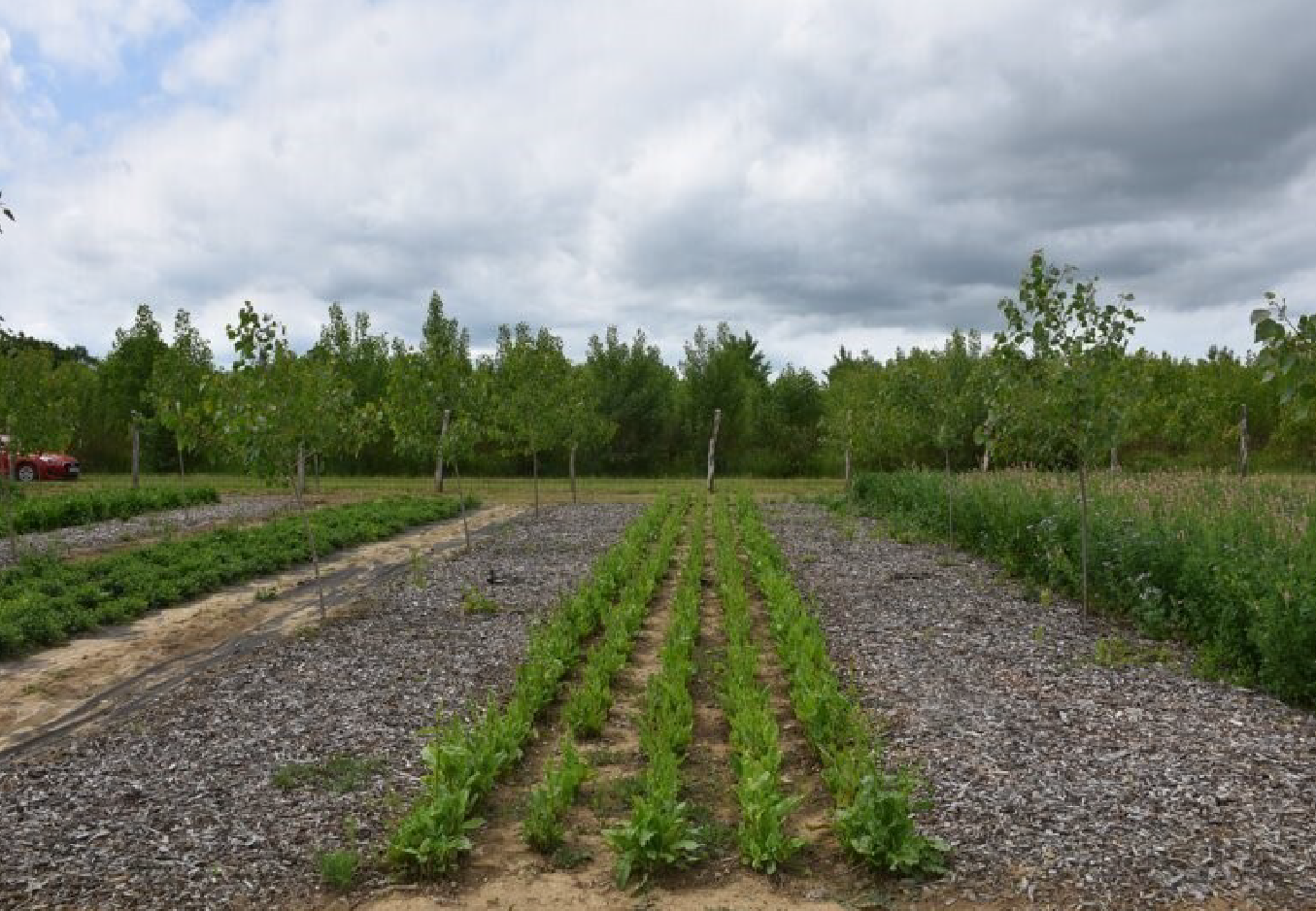
Two years ago, at the very start of the ReForest project, we visited the Bajti Breeding Yard research centre near Sárvár — a compact, carefully designed half-hectare alley cropping experiment established in 2021 by the University of Sopron’s Forest Research Institute. The site was set up with a clear purpose: to test whether agroforestry systems could be successfully adapted to Hungarian conditions, combining poplar timber production with medicinal herb cultivation, bee pasture, and soil cover research. At the time, the experiment was young and the data still thin. Today, the poplars are growing well, the first results on antioxidant content and soil biodiversity are in, and the team has a clearer sense of what the system can and cannot yet tell us. In this follow-up conversation, we return to Bajti to hear what two more years of careful monitoring have added — and where the research still has further to go.
The site was established in 2021. Has the landscape or structure of the system changed significantly since then?
From a landscape, structural, or functional perspective, the site has not changed substantially. The work of the past two years has been about detecting change through targeted investigation rather than redesigning the system. At this stage of an agroforestry experiment, that’s exactly the right focus — building a robust baseline that makes future changes interpretable.
One of the key challenges was improving the microclimate — particularly humidity and protection from scorching summer heat. Is there evidence the system is working?
We can speak to this based on indirect evidence. The alley cropping system has consistently produced satisfactory yields in both quantity and visual quality, which suggests the microclimate is providing some buffering effect. That said, there is a high-risk window of roughly one month in midsummer when conditions become very challenging — Vinca minor showed yellowing during peak heat despite the shade the trees provide.
It’s a reminder that even well-designed agroforestry systems don’t eliminate climate stress entirely — they modify it. The question of how much protection is enough, and under what conditions, is something we’re still working to quantify properly.
The poplars were chosen for fast growth and intensive pruning management. How have they developed — and did the early Fusarium and bacterial infections cause lasting damage?
The trees have recovered well. The planting material we received was infected with Fusarium fungus and Lonsdalea bacteria, which was a concerning start, but the trees regenerated successfully and are now growing as expected and in good condition.
Looking ahead, the rapid growth of the poplars is beginning to raise a different question: as the canopy develops, shading will increase, and we need to understand whether that will start to suppress the medicinal herb intercrops beneath them. Investigating the possible negative effects of progressive shading is one of the research priorities for the next phase.
One practical lesson has already emerged clearly from the spacing design: six metres of row spacing is insufficient for this poplar clone. For intercropping to work effectively, the distance needs to be at least ten metres — something worth building into any future system design from the outset.
“Six metres of row spacing is not sufficient for clone I214. In the case of intercropping, the distance should be increased to at least ten metres.”
The intercrops — narrowleaf plantain, periwinkle, sorrel, and bee pasture mix — were central to the research design. What have the results shown so far?
Quantitative performance has been satisfactory across the board. The more detailed work has focused on antioxidant content — a quality parameter that matters for medicinal plant applications — and the picture is nuanced.
For common sorrel, spring samples grown under mulch and bee pasture covers showed the highest antioxidant capacities. For ribwort plantain and dwarf periwinkle, the soil cover treatments did not significantly affect antioxidant content — spring consistently produced the highest values regardless of cover type, with summer the lowest. The overall finding is that the effect of soil cover on antioxidant content is highly species-dependent, and no single cover treatment reliably boosts quality across all species. That’s a useful result for farmers to know, even if it complicates the picture.
What have the different soil cover treatments — mulch, geotextile, and bee pasture — revealed about conditions below ground?
The treatments have produced meaningfully different outcomes. Mulch retained the most soil moisture and helped cool the soil — both valuable in a system facing summer heat stress. Bee pasture produced the highest nutrient levels. Geotextile, by contrast, increased soil temperature and showed significantly lower earthworm numbers and biomass compared to the mulch and bee pasture treatments.
The earthworm finding is particularly noteworthy. There was no significant difference in earthworm populations between the agroforestry area overall and the treeless control — but the soil cover choice within the agroforestry system made a measurable difference. Geotextile is clearly the least favourable option for soil biology, which has implications for how the system should be managed going forward.
“Geotextile treatments showed significantly lower earthworm numbers and biomass than mulch and bee pasture — soil cover choice matters as much as tree presence.”
The biodiversity monitoring extended to ants and soil microarthropods. What did those surveys reveal?
Eight ant species were identified within the agroforestry system — a richness comparable to the more diverse neighbouring stands, and clearly higher than the less varied areas nearby such as pine forest and cutting propagation stock plantations. The ant community showed traits typical of a moderately disturbed environment, which is consistent with the relatively young age of the system.
For soil microarthropods, bee pasture plots produced the strongest results — taxa richness between 8 and 11, and soil biological quality index values between 93 and 108. Wood chip cover also performed well on both measures. Several protected species were also recorded on the site, though the surveys were primarily presence-absence assessments rather than population counts.
Has being part of the ReForest network influenced the research here?
Not in terms of methodology harmonisation or direct comparative studies — the experimental conditions across the ReForest living labs are too varied for straightforward comparison, and the methodologies used weren’t fully aligned. What ReForest has done is strengthen the connection between research and practice, and enhance the demonstration and educational role of the site. That’s a genuine contribution, even if it’s different from the kind of cross-lab scientific integration that might have been hoped for.
Looking back, what counts as the biggest achievement so far — and what is the most pressing challenge ahead?
Successfully excluding wildlife from the site has been the single most important operational achievement. Without the game fence, the experiment simply wouldn’t have been viable — wildlife pressure on young agroforestry plantings is a serious and underappreciated constraint.
The most urgent practical challenge now is the resowing of sorrel and ribwort plantain. Both are short-lived perennials that need to be resown every three to four years — which means this isn’t a one-time task but a recurring management commitment that needs to be built into the system’s long-term operational plan.
More broadly, the three priorities for the coming years are straightforward to state and harder to solve: maintain the experiment, find the personnel to carry out systematic measurements, and find markets for the produce. Long-term experimental research is resource-intensive in ways that short-term funding cycles don’t easily support.
This blog article is developed as a result of the co-creation work with Living Labs coordinated by EMEA with the support of Project partners and living Lab leaders.
 Spanish
  English
  German
  French
  Danish
  Hungarian
  Czech
Czech  Bulgarian
  Dutch
Dutch